



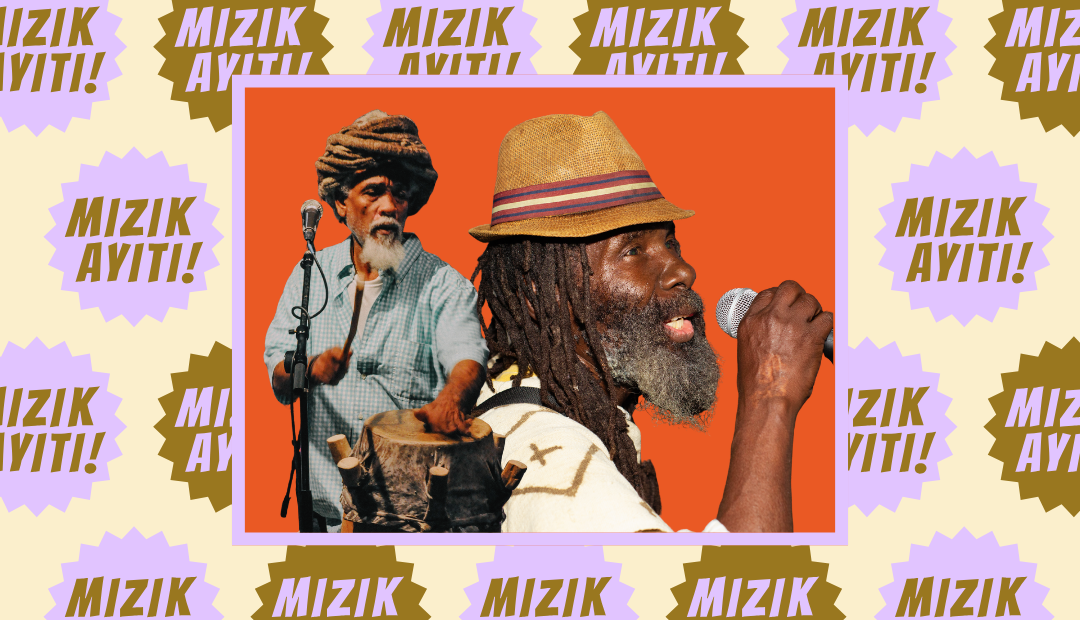
Join HCX on Thursday nights for the second edition of the Mizik Ayiti! Residency Series. The Late Fall residency will be held by Bonga Jean Baptiste & Sanba Kebyesou.
Heralded for their skill as musicians, educators, and culture bearers, Bonga and Kebyesou Danlè maintain the power of Haitian culture held in the tanbou. With a wide-ranging repertoire of Haitian traditional rhythms, they have revitalized the rasin mizik movement through their many years on stage.
Bonga and Kebyesou are founding members of the band Foula. Their name, originating from Congo and meaning “the breath of life,” now feels almost prophetic as Foula breathes new life into Vodou music, lifting it out of the purely ritual space and transforming it into a modern artistic language without stripping it of its sacred essence.
Bonga and Kebyesou’s music continues to be listened to, sampled, remixed, and studied, with their band Foula’s album Voodoo Jazz from Haiti now considered a classic, included in international selections of “essential Haitian albums.”
This powerful duo with unique weekly performances and guest musicians awaits you for five nights this Fall.
—
Dates & Tickets
Get your tickets today and don’t miss out on these incredible performances!
Performance will take place weekly on Thursdays this Fall:
November 5, 12 & 19 and December 3 & 10
6-9pm (45 min sets at 6:30 & 7:45)
Get your tickets to one, or all these performances, here »
Tickets include a complimentary beverage.
Special pop-up offerings from Bon Pâtés.
Limited capacity, RSVP strongly recommended.
—
HCX | Mizik Ayiti! Residency
HCX positions this invitational residency as an opportunity to innovate and workshop concepts and works-in-progress, showcase new work, and build networks for artists’ future presentation (e.g. booking, touring) at other cultural institutions and stages.
Rarely do artists receive a consistent opportunity to create and share in “real time”–to develop their ideas in a beta form, experiment, and refine amidst presenting publicly. Over the course of 6 weeks, resident artists receive a platform to fine tune approaches, activate jam sessions, and explore sonic possibilities while developing relationships with their audiences.
On Thursday evenings, artist-composers host unique sets joined by a rotation of guest artists and ensembles. Performances offer the opportunity to showcase new work and workshop arrangements across the musical landscape, from traditional genres reverberating the strength of the tanbou to the contemporary sound like fusion jazz and electronic music carrying Haitian vibration into the future.
—
About Bonga Jean-Baptiste
 Gaston Jean-Baptiste, known as Bonga, is a musical virtuoso who has been performing and studying traditional Haitian drum, dance and song since the age of seven. He began playing drums in his family’s peristil in his hometown of Croix-des-Mission in La Plaine, an area of Haiti known for culture and history.
Bonga is regarded as a master of the Afro Haitian drum, sought-after for his extensive repertoire of pan-African rhythms. A dynamic performer, accompanist, session player and educator, Bonga works on stage, in the recording studio, and in educational settings. He is one of the few drum experts and craftsmen outside of Haiti who continues to build traditional drums using techniques that are centuries old.
As a core member of the seminal Haitian roots bands, Boukman Eksperyans and Foulà, Bonga was invited to the U.S. in the ’90s when musicians were becoming a strong voice for the Haitian people. Since then, Bonga has continued to play solo and in ensemble and at numerous worldwide venues. He is a featured performer with Peter Yarrow, Grace Jones, Dan Zanes and Urban Tap, to mention a few. His drums opened the NY premiere of the Rolling Stones “Voodoo Lounge” tour, and he is prominently featured on recordings by Wyclef Jean and Salif Keita.
Bonga’s first CD, Kanzo (2000), incorporates elements of jazz, blues, and funk to create a dynamic version of mizik rasin. The recording features Lou Reed, bassist Fernando Saunders, and trumpeter Frank London. Bonga’s second CD, Ayiti Afrika (2006), received critical acclaim. Featuring cellist Rufus Cappadocia, multi-instrumentalist Peck Allmond and Guinean balafonist Famoro Dioubate, Ayiti Afrika explores the African roots of Haitian music.
—
About Sanba Kebyesou Danlè
 Jean-Raymond Giglio, also known as Sanba Kebyesou Danlè (or simply Sanba Kebyesou), is one of the pioneers of the Vodou Jazz and Rasin movement out of which come bands like Boukman Eksperyans, Boukan Ginen, and others. His performance history is organic, generative and has brought him to the stage to accompany musicians ranging from Tafa Mi-Soleil, James Germaine, Pauline Jean, and countless others.
The story of Sanba Kebyesou and Foula begins in 1978, in a Haiti caught between political tensions and a cultural effervescence searching to reclaim its roots. A group of young musicians, led by Jean-Raymond ”Sanba Kebyesou” Giglio and Wilfrid “Tido” Lavaud, sensed that within the ancestral rhythms of Haiti lay a force worth rediscovering.
Giglio and Lavaud began by traveling through villages, attending Vodou ceremonies, recording rhythms, observing dances, and listening to stories. At that time, they were closer to ethnomusicologists than performers, fascinated by how Petwo, Rada, Banda drum patterns and vaksin — those bamboo or metal trumpets — could tell the history of a people without uttering a single word. In 1981, after years of documentation, they decided to transform this knowledge into a band.
Foula was born as a sonic laboratory, a space where Vodou tradition was preserved intact, yet opened toward modern harmonies. They were soon joined by Chico Boyer, a bassist and vocalist with a rare melodic-rhythmic sensitivity, Gaston Bonga Jean-Baptiste, one of the most important percussionists of his generation, and Thurgot Theodat, the saxophonist who would become the voice of air in a music dominated by earth and fire.
In 1993, the band released the album Foula, which quickly became a landmark album released by Blue Vision in Germany and carried their music even further. Today, the album is considered one of the finest examples of the fusion between Vodou and jazz, a record that influenced entire generations of artists, from rasin musicians to explorers of world jazz.
Foula was among the first groups to transform Vodou into a contemporary artistic language, paving the way for bands such as Boukman Eksperyans, RAM, Ayibobo, and Lakou Mizik. At a time when many rara groups were disappearing or modernizing superficially, Foula managed to preserve the essence of tradition and pass it on to a new generation.