



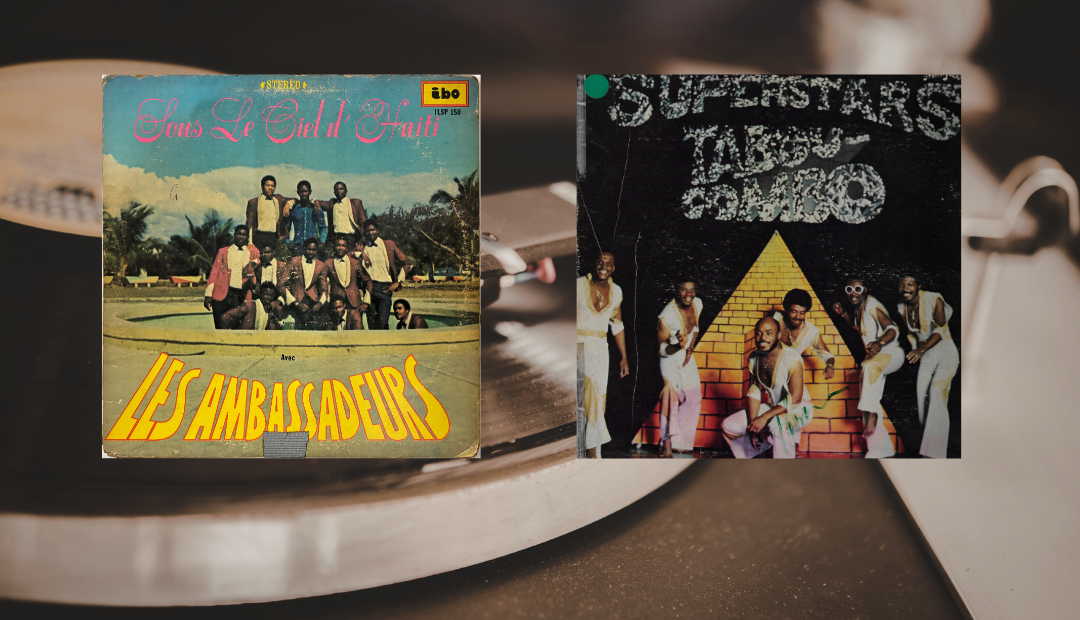
In this interactive salon, reimagine the classic Haitian immigrant living room: sofas covered in squeaky plastic protecting the fabric below, the ceramic decorations and the photo albums and the China and the bars with Rhum Barbancourt, crémas, Manischewitz, and tranpe lined up in a neat row. In the corner of the room: a record player.
Scholar, archivist, and artist Hervé Sabin brings us together to reminisce on iconic musical genres of mini-jazz and konpa direk and how they made their way to Brooklyn in our suitcases, bals, and right here in recording studios across the US.
For this session, serenade us with your memories of Haitian mini-jazz as we listen to vinyls from the Ace Frape collection of Jean H. Marcelin and Hervé Sabin’s inherited collections from Montreal, New York, Miami, and Port-au-Prince.
Patrice Espérant joins as the afternoon’s DJ to keep the vinyl spinning!
We welcome you to sit a while, listen to a few of iconic albums, and share stories of home – old and new.
Sunday, March 29, 2026
2-7pm
Haiti Cultural Exchange
35 Lafayette Ave BK, NY 11217
2pm: Welcome & Flip through Marcelin & Sabin’s Records Archive. Sign up to share your Mini-Jazz music memory!
2:30pm: Story Sharing with Hervé Sabin & Patrice Espérant
3-7pm: Community Story Sharing Cycles
—
About Orchestre et Mini-Jazz: An Immigration Story Through Music by Hervé Sabin
During the late sixties compas direct/konpa direk which was founded in July 1955 by Nemours Jean-Baptiste* began transforming from a big band orchestra format to a more compact unit of five to eight members called Mini-Jazz. To this very day most Haitians refer to a compas band as jazz la or the Jazz!
The bands developed structures and distinct sounds. The typical instruments were electric guitars, bass, drums, keyboard, and sometimes brass instruments like saxophones and trumpets. The electric guitar was dominant with intricate solos. Mini-Jazz retained Compas’ distinctive rhythm of steady beat and syncopated bass lines, played at a faster tempo danceable groove.
They were from various neighborhoods in Port-au-Prince and other Haitian cities. In Port-au-Prince, certain bands were known as king of their neighborhood: Les Shleu Shleu were in Bas-Peu-de-Chose; Les Fantaisistes were from Carrefour; in Petionville the bands Les Difficiles which became Les Gypsies, Tabou Combo which was born from Los Incognitos, Les Frères Dejean, Choupa Choupa all dominated the hills of Carrefour Feuille.
The early seventies saw many bands emigrating to the United States in parallel with the great migration spurred by the entrenchment of the Duvalier regime. They settled predominantly in the northeast where Tabou Combo had established itself and became an international superstar (even adding Superstars to the name of the band). They did it with hits such as “New York City”, “Juicy Lucy”, “Chercher la Femme” and “Let’s Dance” which married funk, early hip hop, and Compas to create a hybrid sound representing the era. The city of Boston hatched Volo Volo de Boston and Djet-X, both products of migration.
Here in New York City, Prospect-Lefferts, Flatbush and Crown Heights became the epicenter of the Haitian migration. Franklin, Nostrand, and Flatbush Avenues became the hubs where many record labels erected domicile. Geronimo records, Marc records, Mini Records and Fred Paul were the big players. Albert Chancy from Tabou Combo started Chancy Records which became at one point the label for the band.
This project looks to tell the parallel stories of a musical genre, its transformation along stories of migration that transformed neighborhoods in cities on both sides of the Atlantic in the US and Haiti. It looks at the lives of Haitian in the US and Haiti, particularly their connections to the music and how Haitian urbanism was been shaped by political and economic immigration.
*The famous Sicot vs Nemours konpa direk origin story battles with Sicot developing a nuanced merengue style called Cadence or Cadence Rampa and Nemours having created a more direct 1,2 rhythm.